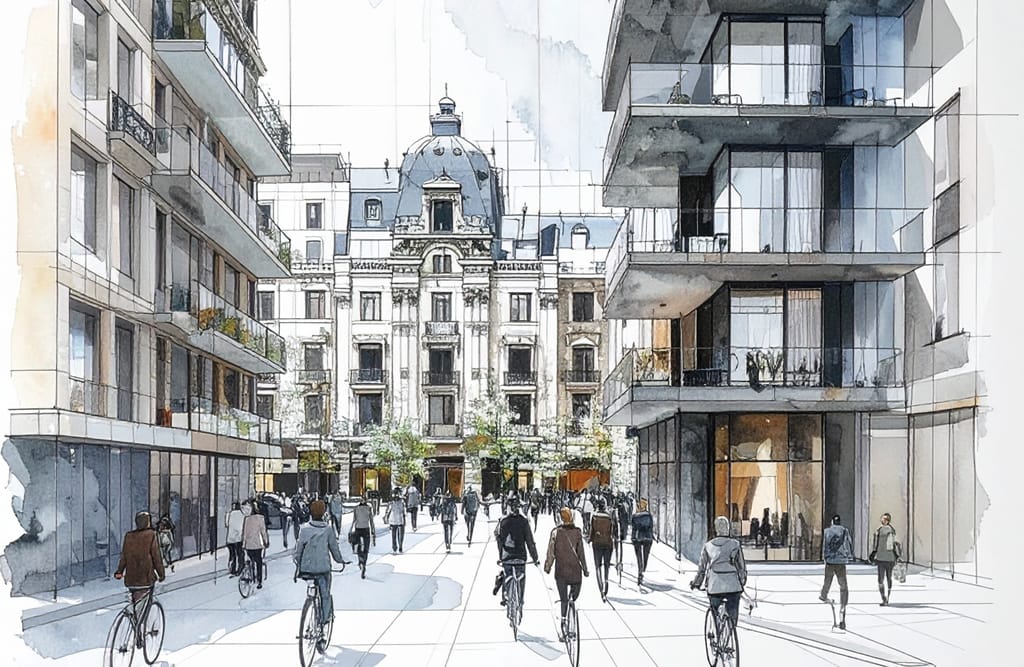
A city is above all a plaza, an agora, a place of discussion and eloquence. In fact, a city doesn’t need houses; facades suffice. Classical cities are based on an instinct opposed to the domestic one. People build houses to live in them, and they found cities to leave their homes and meet others who have also left theirs.
José Ortega y Gasset
Urban design is not a monolithic discipline that applies a single formula to the entire city. On the contrary, it is a multifaceted practice that requires a deep understanding of the diverse fabrics, histories, and dynamics that make up the contemporary metropolis. The city is a mosaic of realities, and the urban designer is the professional responsible for stitching together, healing, and energizing these disparate pieces.
The urban planner’s work ranges from the macro-scale of metropolitan infrastructure to the micro-scale of neighborhood acupuncture. Below, we explore the 11 main scenarios that define the battleground—and the opportunities—for the urban designer today.
1. Industrial Space: From Obsolescence to Opportunity
Former industrial zones, often located in central areas due to urban growth, now represent the largest reserve of land for urban transformation. The designer’s challenge here is not to start from scratch, but to work with the memory of the place. The project focuses on the regeneration of brownfields, soil remediation, and the conversion of industrial buildings into new mixed-use spaces (creative hubs, loft-style housing, amenities), integrating industrial heritage as an asset of identity.
2. Metropolitan Facilities: Stitching the Large Pieces Together
Hospitals, university campuses, stadiums, and large administrative centers often function as “islands” within the urban fabric, creating physical barriers and intense traffic flows. Urban design must intervene to integrate these macrostructures into the surrounding urban fabric. The goal is to dissolve their edges, make their perimeters permeable to pedestrians, and ensure that these giants serve the city, rather than turning their backs on it.
3. Integration of Transportation Networks: Beyond Engineering
Transportation infrastructure has historically been one of the biggest causes of urban scars (elevated highways, impassable railway lines). The current scenario demands a paradigm shift: designing with transportation, not just for it. This implies developing Transit-Oriented Development (TOD) models, transforming urban highways into multimodal boulevards, and ensuring that stations become true centers of civic activity, weaving together the neighborhoods they once divided.
4. Waterfronts
The reclamation of waterfronts is perhaps the most global urban phenomenon of recent decades. Rivers, lakes, and waterfronts, once treated as industrial wastelands or sewers, are being reclaimed for the enjoyment of citizens. The urban designer’s challenge is to guarantee continuous public access, balance real estate and tourism pressures with civic uses, and crucially, design resilient waterfronts in the face of climate change and rising sea levels.
5. Space for Tourism: Managing Success
Intense urban tourism has turned certain neighborhoods into conflict zones. Urban design in these areas must go beyond aesthetics; it must manage flows and tensions. Strategies include decentralizing attractions to alleviate pressure on “hot spots,” designing public spaces that foster interaction between visitors and locals, and protecting local businesses from the over-theming of spaces.
6. Urban Voids and Vacant Lots
Vacant lots, residual spaces beneath infrastructure, or abandoned plots are not “nowhere”; they are spaces of latent opportunity. Urban planners often operate here using tactical urbanism and temporary strategies. These voids are ideal laboratories for urban gardens, ephemeral cultural spaces, or new ecological corridors, allowing for testing uses before permanent investments.
7. Historic and Traditional Centers
Intervening in the heart of a historic center requires precise intervention. The constant dilemma is finding the balance between preserving heritage and contemporary vitality, avoiding both museumification and exclusionary gentrification. Urban design seeks to introduce high-quality contemporary architecture that engages with the existing structure, pedestrianize key axes, and promote youth housing to maintain a vibrant and diverse city center.
8. Service Corridors and Mixed-Use Hubs
Major commercial avenues and service corridors are the lifeblood of the urban economy. The focus here is on the intensification and mixing of uses. The aim is to transform single-use corridors (only offices or only retail) into vibrant 24/7 environments, increasing residential density in higher-rise buildings and radically improving the quality of pedestrian space at ground level.
9. Regularized Traditional and Contemporary Residential Space
From 19th-century urban expansions to 20th-century planned suburbs, these areas require adaptation to new lifestyles. The challenge is to introduce flexibility into often rigid urban fabrics. This involves diversifying housing typologies, introducing small shops and services into exclusively residential areas, and rethinking public space, which is often limited to streets designed primarily for automobiles.
10. Comprehensive Neighborhood Improvement
In informal settlements, urban design becomes a tool for social justice. Intervention cannot be imposed; it must be participatory. “Comprehensive improvement” recognizes the value of the existing social and physical fabric. Key actions include providing basic infrastructure (water, sanitation), creating quality public space through “urban acupuncture,” and improving connectivity with the rest of the formal city, all while minimizing the displacement of residents.
11. Social Housing Settlements
Historically, mass social housing has created stigmatized and disconnected peripheries. The new scenario demands designing cities, not just apartment blocks. Urban designers must ensure that these new developments are integrated with the existing city, have excellent public transport connections, provide educational and healthcare facilities from day one, and offer high-quality public spaces that dignify community life, breaking down the stigma of the “ghetto.”
Conclusion
Versatility is the essential quality of the 21st-century urban designer. Each of these 11 scenarios requires different tools, sensitivities, and strategies. However, the common denominator in all of them is the ultimate goal: to create more equitable, resilient, and humane cities, capable of adapting to the challenges of an uncertain future.